is Predicted to Continue to Fall
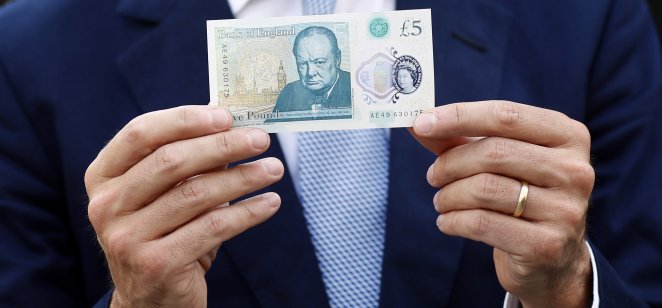
The British pound (GBP) has fallen in value this year amid rising inflation, the prospect of the economy entering recession by the end of the year, political uncertainty and persistent strength in the value of the US dollar (USD).
GBP/USD – or cable, as it is known across currency-trading desks – plummeted to a record low of $1.035 on Monday, 26 September, before recovering to $1.07 as traders bet that the Bank of England might step in to prop up the currency as part of emergency measures following its rapid drop.
Will the pound find support or continue to shed value?
In this article, we look at GBP's recent performance and the long-term outlook for the currency based on foreign exchange (forex, FX) analysts' forecasts.
What drives the value of sterling?
The British pound sterling is the former global reserve currency and one of the world's strongest by value. GBP is the fourth most-traded currency on the forex markets, which reflects its role as the world's fifth largest economy and a major financial centre.
The value of the pound is driven by macroeconomic indicators, including gross domestic product (GDP), inflation, interest rates, services and manufacturing activity, and the UK unemployment rate.
Sentiment has been a key driver in recent years, as uncertainty surrounding negotiations on the UK's exit from the EU has weighed on sterling's value since the 2016 Brexit referendum.
More recently, concerns over the impact of the Russia-Ukraine war on inflation in the UK, the appointment of the country's fourth prime minister in six years, and recent spending plans have added further downward pressure. That has outweighed the effect of the Bank of England (BoE) raising interest rates from 0.10% in December 2021 to 2.25% in September 2022.
GBP hits 37-year low against USD
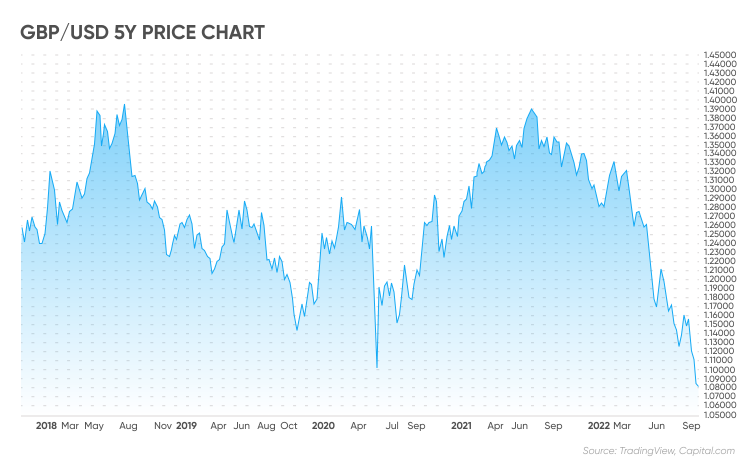
The pound has been in a long-term decline against the US dollar since 2014 when it traded up to $1.70. The pair fell to $1.50 at the start of 2015. After the UK held its Brexit referendum in 2016, it dropped to the $1.23 level in 2016 as investors sold the pound on uncertainty surrounding the vote's impact on UK trade.
GBP/USD rose to 1.40 in 2018, but slid to $1.21 in mid-2019 when Boris Johnson took office as prime minister, increasing the prospect for a 'hard Brexit' with no European trade deal.
The pair moved up to 1.33 in December 2019, but dropped to $1.145 on 19 March 2020 as investors sought safe haven in the dollar at the start of Covid-19 lockdowns.
GBP/USD climbed to $1.4190 in May 2021 as sterling gained after the Scottish National Party failed to secure an absolute majority in elections, reducing the likelihood of a Scottish independence referendum. The economy also reopened from Covid-19 lockdowns, raising hopes for a strong recovery.
The exchange rate has dropped from the $1.35 level at the end of 2021 to dip below March 2020's low in the first week of September. The GBP/USD rate hovered in the 1.14-1.16 range – with the low end last seen in 1985 – as the UK appointed Liz Truss as its new prime minister on 6 September.
Although the UK is not as exposed to Russian oil and gas as its European neighbours, news that Russia was halting the Nord Stream gas pipeline sent already soaring European wholesale energy markets higher still, affecting the UK's economic outlook.
A recently unveiled spending plan, dubbed the "mini-budget" pushed sterling over the edge, as the UK's new chancellor Kwasi Kwarteng cut taxes and boosted borrowing on 23 September to stimulate economic growth and fund the country's response to the energy crisis.
Analysts Antoine Bouvet and Chris Turner at Netherlands-based banking group ING called recent events a "perfect storm" in their review of the decision:
"Sterling has been trading off fiscal concerns since early August. Expect this to remain the dominant theme as international investors again consider the right price, both in terms of sterling and gilt yields, to fund the UK's widening budget deficit.
"We have to remember that FX is probably the easiest vehicle to trade UK country risk – given that there is not much liquidity in sovereign credit default swaps for the UK. On this subject, investors will take great interest in what the rating agencies have to say about UK fiscal plans. The UK's long-term sovereign outlook is currently stable at all three of the rating agencies, S&P (AA), Fitch (AA-) and Moody's (Aa3). The risk of a possible shift to a negative outlook will come when the ratings are reviewed on 21 October (S&P and Moody's) and 9 December (Fitch)."
"The pound was already getting weaker, but the announcement of the Growth Plan 2022, which calls for huge tax cuts to be financed by deficit spending, sparked extreme volatility in the currency and gilts market," said Capital.com's chief market analyst Piero Cingari.
"Investors are uncertain about the government's fiscal plan because it differs significantly from the Bank of England's monetary policy. The latter also ignored expectations for a larger rate hike in September," he added.
The pound shed 3.5% of its value after the announcement of the "mini-budget" on Friday 23 September and tanked further still as markets reopened on Monday 26 September – the start of trading in Asia on Monday brought a 4% drop against the dollar to a record low of just under $1.04.
Rumours of the Bank of England stepping in to calm markets with an emergency rate hike brought the rate to $1.07 – still the weakest point since 1985.
"It is not a good sign that the market could not find natural buyers until it hit that point," commented Katie Martin, markets editor at the Financial Times. "The financial crisis, Covid and the exit from the European Exchange Rate Mechanism all hit the pound hard, but nothing has ever pushed it this low before."
What is the outlook for the pound for the remainder of the year and the long term?
GBP forecast: How will the pound trade against USD and EUR?
Analysts at UK-based currency exchange firm Monex are bearish in their GBP prediction against the US dollar and the euro:
"Given the substantial deterioration in both the UK's economic outlook and its balance of payments over the course of August, we are downgrading our GBP forecasts against USD and EUR both to mark-to-market and to reflect our increasingly bearish view on the pound."
"Under our base case assumption, Liz Truss… should provide a sizeable level of fiscal support for businesses and households through the winter months. Nevertheless, this does little to offset the bearish sentiment being factored into GBP at present given the increasing left tail risk to the UK economy and the need for the Bank of England to tighten policy further in order to mitigate against the second round effects of the latest inflation shock. Until year-end, we view the risks to our GBP forecasts as tilted to the downside."
Analysts at ING were of a similar opinion, even forecasting a potential break of parity for GBP/USD later this year:
"At this stage, we think UK authorities will probably just have to let sterling find its right level. The UK has a reserve currency so it can always issue debt – it's just a question of the right price.
"We are still bullish on the dollar this year as Fed leads the deflationary charge and global growth slows. That means GBP/USD is now vulnerable to a break of parity later this year, while – quite unexpectedly – EUR/GBP can make a run towards the March 2020 high of 0.95, with outside risk to the 2008 high of 0.98."
GBP/USD forecast: Has sterling bottomed out?
As the differences between the UK and US economies become clearer, and with Britain's new spending plan doing little to support the pound, let's take a look at analysts' recent GBP/USD forecasts.
In a recentG10 FX Daily Updateissuedon 26 September 2022, Scotiabank analyst Shaun Osborne said: "Chancellor Kwarteng's mini-budget is not so mini; the Chancellor unveiled sweeping personal and corporate tax cuts, a reduction in the stamp duty on property purchases and support for the economy from surging energy costs among other measures. The massive tax cuts are somewhat reminiscent of the Conservatives' tax slashing moves which boosted inflation in the late 1980s."
"The pound has plunged in response while gilts have cratered (10YY up 23-24bps) as markets fear 1) more aggressive BoE rate hikes and 2) foreign investors shying away from UK debt because of the impact the plans will have on public finances. Swaps are pricing in 96bps of BoE tightening for the Nov policy decision. Sterling is some 2.5 cents off yesterday's high near 1.1350."
Technically, Osborne was also bearish on the GBP/USD rate, saying: "Weak price action persists in the GBP, with the pound plunging sharply in European trade to below 1.11 briefly. Trend momentum favours the USD continuing to gain here in the medium term but price action is looking overextended in the shorter run and a snap higher is not to be ruled out to relieve oversold pressure on the GBP. Scope for gains is likely limited, however. Support is 1.1075, 1.10 and big figures below."
In their latestS on 19 September 2022, analysts at Citibank's Hong Kong office downgraded their forecast for GBP/USD, quoting a a "new fiscal risk" emerging:
"We downgrade our near-term forecast to 1.10. The UK current account is being eroded by high energy prices and Brexit. The domestic growth picture remains very weak. This is leading to capital account inflows drying up at a time when the UK needs them most, as evidenced by collapsing inbound M&A.
"A new fiscal risk is emerging. The UK is set to fund around GBP 150bn worth of spending across energy price support for households and businesses combined with broad tax cuts via gilt issuance. GBP/USD would need to close below horizontal support at 1.1412 (2020 low) to targe 1.0520 - 62 (1985 low and 12-year descending support)."
In her latest video on the currency pair, Capital.com analyst Daniela Hathorn outlined the following support and resistance levels to watch in upcoming weeks:
Resistance
1.1744(Last week's high)
1.2290 (August high)
1.2666(May high)
Support
1.1000(Psychological level)
1.0765(Low week 18th February 1985)
1.0514(1985 low)
GBP/EUR forecast: How will the pound fare against the euro?
Monex Europe updated its GBP/EUR forecasts in early September and has yet to change them in light of recent fiscal events.
The forex firm said:
"Given the substantial deterioration in both the UK's economic outlook and its balance of payments over the course of August, we are downgrading our GBP forecasts against USD and EUR both to mark-to-market and to reflect our increasingly bearish view on the pound."
According to Monex, the currency pair could rise to 1.165 in six months – by 28 February 2023 – but fall again to 1.12 in a year's time.
Economics data provider TradingEconomicsforecast that GBP/EUR could be priced at 1.11884 by the end of this quarter and at 1.11404 in one year's time.
As of 26 September 2022, algorithm-based forecast website WalletInvestor considered the pair to be a "not so good long-term (1-year) investment".
The platform's GBP forecast for 2022 in relation to the Euro had the pair finishing the year at an average of 1.101. WalletInvestor's forecast for GBP in 2025 against the EUR was a steeper average of 1.153 by December that year. According to the website, the pair could rise to average 1.182 by September 2027. There was no GBP forecast for 2030.
When looking at any pound forecast, it's important to remember that currency markets are highly volatile, making it difficult for analysts to make accurate long-term predictions. We recommend that you always do your own research, looking at the latest market trends, news, technical and fundamental analysis, and expert opinion before making any investment decision.
FAQs
Why has the GBP been dropping?
The British pound sterling has fallen in value on a combination of rising inflation, fears of an approaching recession, political uncertainty, a strong US dollar and a recently-unveiled spending plan that will cut taxes and boost spending, expanding the UK's deficit.
Will the GBP go up or down?
The direction of the pound against other currencies could depend on the UK's economic performance, monetary policy and the new UK government, among other factors.
When is the best time to trade GBP?
The busiest time for the GBP market is typically during European trading hours between 07:00-16:00 GMT. Releases of major macroeconomic data and monetary policy statements tend to drive volatility on currency markets, increasing liquidity and creating opportunities for traders to profit. However, you should keep in mind that high volatility increases risks of losses.
Is GBP a buy, hold or sell?
The trading position you take on GBP is a personal decision you should make based on your risk tolerance, investing strategy and portfolio composition, after researching the market to understand the latest trends, news and analysis. Keep in mind that past performance is no guarantee of future returns. And never invest money you cannot afford to lose.
Related reading
Source: https://capital.com/british-pound-forecast-will-gbp-rise
0 Response to "is Predicted to Continue to Fall"
Post a Comment